
Maturity of data-driven decision making
There are 4 levels of analytics maturity a company can achieve - with each level enabling more data-driven decisions and more business value.
Traditionally, a scaled analytics landscape was something only large corporations could afford. They built extensive data warehouses—massive projects involving large teams of people working for months or even years—to establish that “single version of truth” which enabled them to produce consistent and accurate reports automatically.
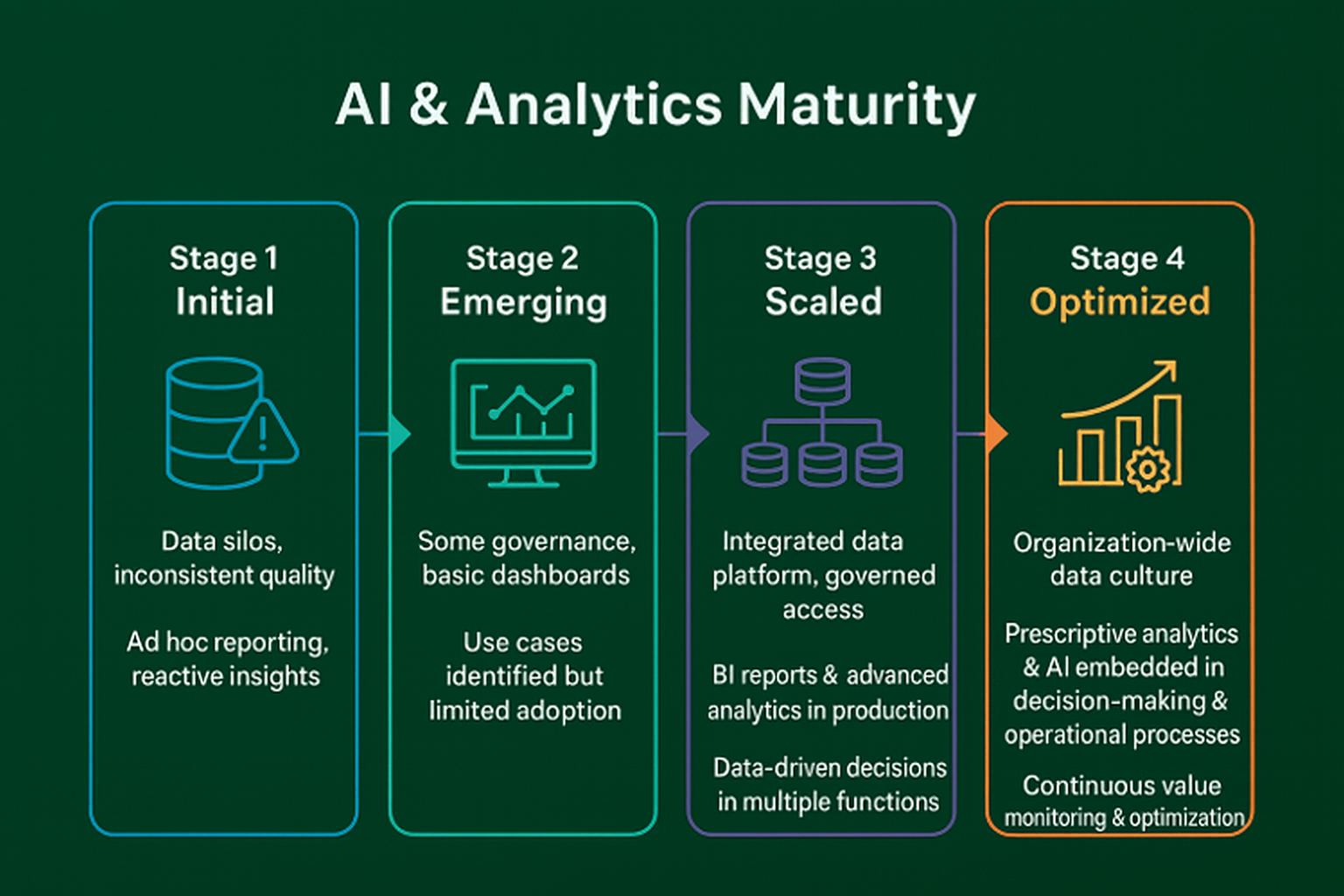
Nowadays, with the technology available, it is entirely possible for any company to generate value from its advanced analytical capabilities. The company should be focused on working with expert teams, adopting modern analytical tools and fostering a data-driven culture to be able to consistently generate value from data, as the market & technology landscape evolves.
-
Initial Stage:
A very small company might start seeking insights from the data generated due to its day-to-day activities. Start small with data sources like your e-shop, accounting software, and social media marketing platforms. One or two business data analysts who know the business and have adequate skills in spreadsheets (e.g. Excel, which has become increasingly powerful in recent years, with embedded AI and programming capabilities available), should be more than enough. -
Emerging Stage:
As the company grows into the small state, the need for aligned decision making emerges. More people require accurate and consistent information compiled under a common set of assumptions and rules. Self-service analytics tools (e.g. Power BI) become useful. They enable a standard set of definitions that drive automatic data tranformations, more elaborate data quality controls, reports that can be refreshed automatically, and reusability of consolidated datasets & calculations, reducing costs even further. -
Scaled Stage:
As a company grows further into the medium state, new needs arise. A centralized data platform that enables consistent and accurate reporting, self-service analytics, and consolidated & readily available data (which can even be semi-structured or real time) are required to power advanced analytics. Also at this stage AI enablement might be an important productivity driver. And all those capabilities must go hand in hand with security and ease of use, as the company has grown significantly. At the same time, resources might still be limited and -as always- costs must remain under control, so flexible yet powerful platforms and an agile mindset are essential for success. -
Optimized Stage:
Any company which tries to progress to that stage, needs a diverse set of tools to support all the important processes and business lines. Capabilities such as financial modelling, risk management, production & process optimization, marketing mix impact understanding, are paramount. Advanced skillsets differentiate the team composition, and a common ground is necessary for frictionless, advanced analytics, and increased productivity. Modern AI chatbots and agents, real-time reporting and analytics, and in-process control and monitoring, should be appropriately orchestrated and enabled through holistic data and analytics platforms such as Azure Databricks, Microsoft Fabric, Snowflake, etc., a diverse toolset of analytical tools like Excel, Power BI, R, Python, and even dedicated analytical software for specific applications & work-streams.
Needless to say, fostering a data-driven culture and empowering people within the company to leverage and extract value from these analytical capabilities is a critical prerequisite for these initiatives to make sense and offer significant business value.
Relevant Case Study
While I’ve worked with many large corporations, it was during my 5+ years leading the BI & Analytics team at PeopleCert that I helped an SME reach a Scaled (Level 3) level of analytical maturity—even before GenAI and modern cloud platforms were available. Together with my team, we managed to:
- Increase Reporting Analysts' productivity 10-fold through Self-Service Analytics capabilities
- Establish a Data-Driven culture, which impacted the quality of decisions as well as operations (e.g., the timeliness and completeness of invoiced exams)
- Build the Enterprise Data Warehouse, which serves as the ‘single version of truth’ for decision-making
- Develop Automatic Reports & Advanced Analytics deliverables to:
- Support strategic decisions through value stream monitoring & process mining
- Inform business stakeholders through tactical sales reports across regions & product lines
- Provide automatic P&L, budget monitoring and other financial reporting capability
- Promote quality of customer service & online proctoring through KPI's & six sigma metrics
- Monitor procurement & examinations processes through tactical & operational BI
Today Peoplecert is not an SME any more. It is a global player with over €1bn valuation!